This post documents my experiments with wire gauges using Virginia Osterland's pattern (more or less) for snapdragons.
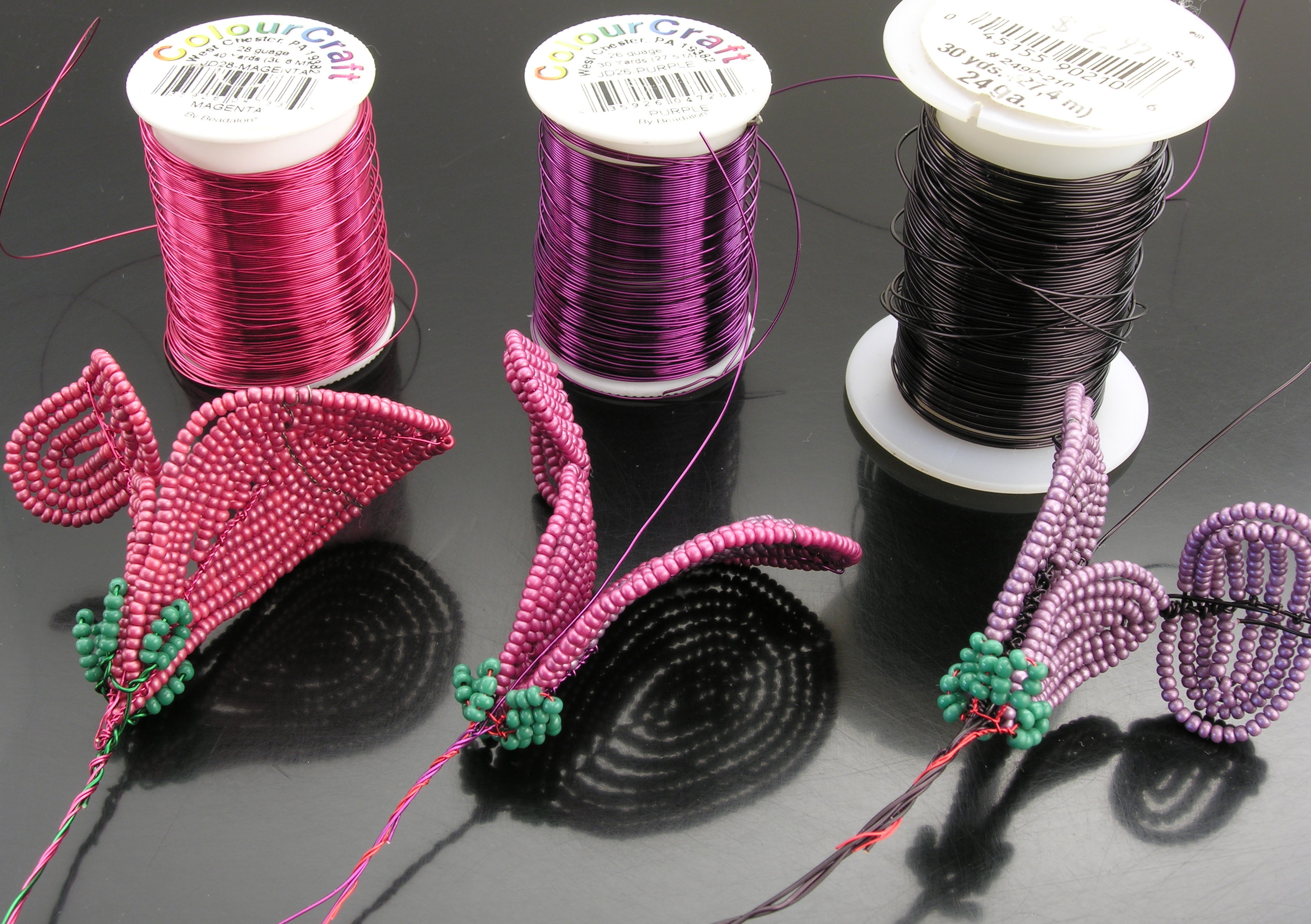
3 snapdragons blossoms made with 28, (magenta) 26, (purple) and 24 (black) ga wire, respectively.
Stamens were derived from the petals, reducing support for heavy petals—this part of the pattern is from Carol Benner Doelp's snapdragon pattern, which is quite a bit different. In fact, I have three different patterns (or did, before I took the Osterland back to the library—really, I must buy this book, now that Dover's reprinted it) and they all use different approaches. The Osterand uses a double basic to make the bottom half of the flower as you see in the purple blossom all the way to the right; the Doelp a split basic; and Dalene Kelly, with what is perhaps the most innovative approach, cup shaped components, normally reserved for flower centers, for both top and bottom components. Kelly also uses a variation of this trick in her bleeding heart pattern, and as I'm becoming more familiar with the medium's toolbox, I'm starting to see things in some of my books that I originally glossed over because I didn't know enough to catch the hints.
Calices (what I always called sepals) were made with either 30 ga red coated copper or green coated 24 ga wire.
The 30 calices did not provide much support—just barely enough for purple, and not needed for black. But the magenta blossom was so floppy I made a 24 gauge calyx, with more beads (9 instead of 7) —obstensibly to make ‘leaves’ of calyx longer, but extra beads were taken up by greater thickness of wire. The heavier wire calyx actually serves to support blossom.
I started with 24 ga black wire because that's what I had when I began this project; but after my parawire order arrived, I was actually willing to use some of my other, older colored wire, because I now had plenty.[1] The 24 ga wire was hard on wrists and hands[2] , and very visible; the thinner stuff kinda floppy. 26 seemed to be the happy medium. Experimenting with wire gauges is an important part of the process.
file created, initial notes, & photo 20080430, most[3] of post 8may08.
Unless otherwise noted, text, image and objects depicted therein copyright 1996--present sylvus tarn.
